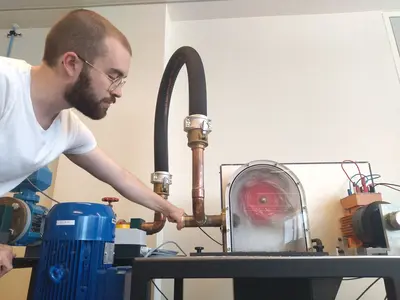
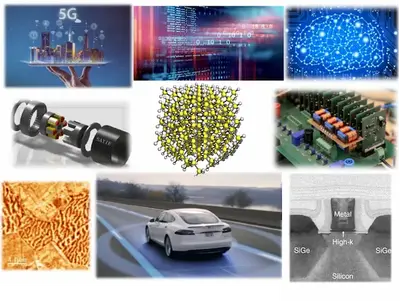
About DER SIEN
Youtube est désactivé. Autoriser le dépôt de cookies pour accéder au contenu.
4 Good Reasons to Join Our Department
- Programs at the highest technical and scientific level.
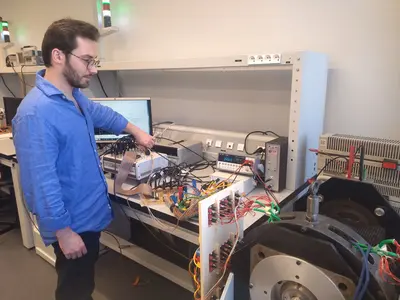
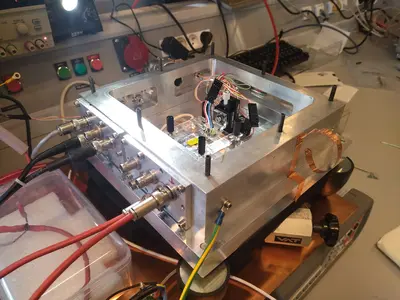
- Extensive practical experience based on innovative projects.
- Strong ties to research; approximately 90% of DER students go on to pursue a Ph.D.
- Wide range of academic and industrial career opportunities
Training Courses
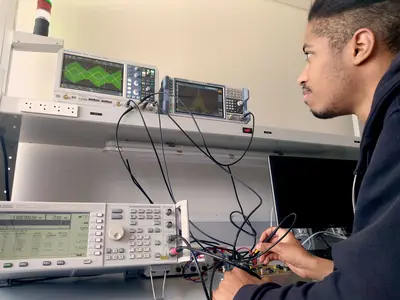
The four-year degree program covers a wide range of topics, from applied physics to electronic and electrical components and systems, as well as applied mathematics and algorithms for signal processing and system control.
Major Career Opportunities
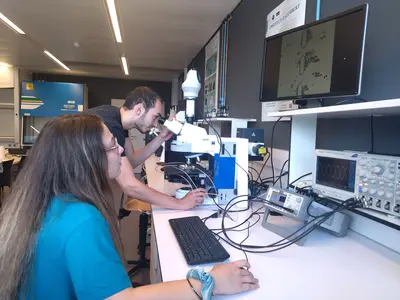
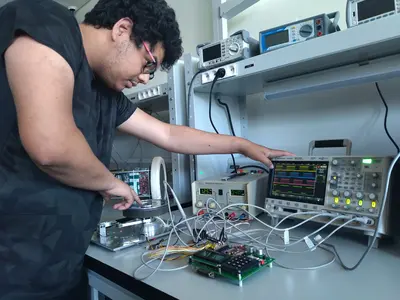
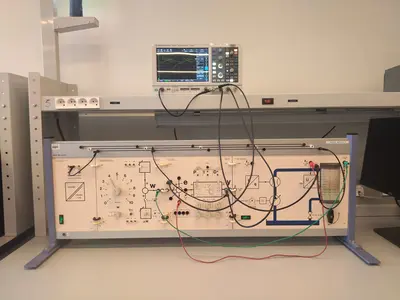
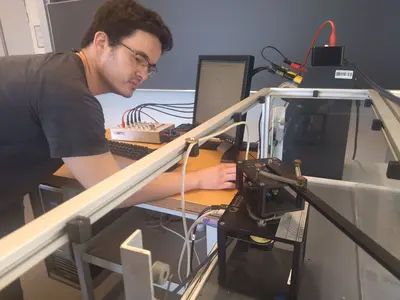
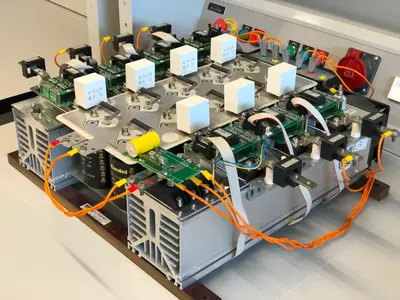
DER in Pictures
Key Partners
Major Industrial Partners
- RTE
- EDF
- SAFRAN
- AIRBUS
- THALES
Key Academic Partners
- CNRS
- CEA
- IFPEN
More information
The decree of June 11, 1891, established the teacher-training program for technical education at the École des Arts et Métiers in Châlons-sur-Marne. Subsequently, other sections were created at various grandes écoles before being consolidated in Paris in 1912 under the name École Normale de l’Enseignement Technique (ENET).
The department moved “temporarily” into the ENSAM building on Boulevard de l’Hôpital, which was nearing completion. The Teacher Training Program A, reserved for boys, consisted of four main subjects: industrial physics and electricity, industrial chemistry, and industrial mechanics. The term industrial distinguishes it from the school on Rue d’Ulm. Section B is dedicated to industrial drawing, technology, and applied mechanics.
The École Normale Supérieure de l’Enseignement Technique (ENSET) was founded in 1932; it became an independent institution, and new sections were created.
The 1948 reform established Sections A1, A2, B, and EG. Electrical engineering was taught in Section A1, while Section A2 was reserved for applied sciences and home economics (open to girls!)..
After the 1952 reform, electricity remained a branch of physics and was taught in Section A'2.
In 1975, the transfer of the humanities sections from ENSET to Fontenay/Saint-Cloud led to a reorganization. The Department of Electrical Engineering was created, and students were enrolled in sections A'2 (applied physics) and B4 (electrical engineering). Electronics and control systems took on an increasingly prominent role in the B4 curriculum. This also marked the beginning of research activities in the Department of Electrical Engineering, which would lead to the creation of LÉSiR around 1980, later renamed SATIE in 2002.
The transformation into the École Normale Supérieure de Cachan in 1985 officially established the campus’s mission to train researchers, which strengthened research at LÉSiR.
The department was renamed Electronics, Electrical Engineering, and Automation during this period. During their studies, students in the department are divided between the electrical engineering bachelor’s programs on the Cachan campus and the EEA program on the Orsay campus; where they are grouped together in the EEA master’s program, then split again between preparation for the electrical engineering agrégation and the physical sciences agrégation with a specialization in applied physics. It should be noted that the EEA department hosts the oral exams for both agrégations each year.
When the Brittany branch of the ENS de Cachan was established in 1994, an annex of the EEA department was created, which later became the Department of Mechatronics.
Starting in the early 1990s, virtually all students in the department enrolled in a DEA program after earning their agrégation, and a growing proportion went on to pursue a Ph.D., reaching approximately 80% by the 2000s.
The LMD reform was implemented in 2005: the sections were eliminated, and all students were enrolled in L3 and then M1 at Orsay, while preparation for the agrégation exams remained unchanged.
Starting with the 2011 academic year, the department’s first year is shared with those of the civil engineering and mechanical engineering departments: this is the SAPHIRE year (Applied Sciences in Physics and Engineering for Higher Education and Research).
Starting with the 2012 competitive exam session, no positions are offered for the physical sciences agrégation with a specialization in applied physics. The corresponding Master’s 2 program in Higher Education Teacher Training will continue for three years within the department.
Since the 2013 competitive exam session, the Agrégation in Electrical Engineering has been replaced by the agrégation in industrial engineering sciences with the industrial sciences and electrical engineering track (whose oral exams, starting with the 2014 session, are no longer held in Cachan).
Starting with the 2017 exam session, the Agrégation in Industrial Engineering Sciences includes a new track, Industrial Sciences and Computer Engineering. Following this expansion, the department once again offers two Master’s 2 programs in Higher Education Training (M2FESup): in Physics of Electrical Energy and Electronic Systems (PSEE) and in Computer Engineering, Signal Processing, Control Systems, Electronics, and Telecommunications (INTRANET).
In early 2020, ENS Cachan moved to the Saclay campus at the heart of Paris Saclay University, of which it is a founding member. The school is now called the École Normale Supérieure Paris Saclay.
In September 2021, the EEA Department became the Nikola Tesla Department of Teaching and Research, with the aim of fostering the integration of teaching and research.
In 2025, the Department of Teaching and Research adopted the name Electrical and Digital Engineering Sciences (SIEN), to better reflect the growing importance of digital sciences in its activities.