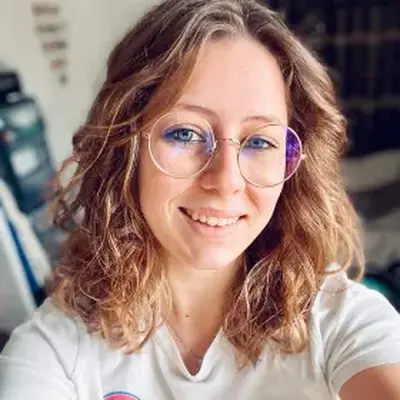
Mélanie PIETRI enrolled at ENS Paris-Saclay in 2019 in the Saphire program, which is the first year of a joint curriculum in mechanical engineering, civil and environmental engineering, and electrical engineering.
She then specialized in the Nikola Tesla Teaching and Research Department (electronics, electrical power, and automation). She completed the MVA (Mathematics, Vision, Learning) master’s program during her final year of study.
She has been a Ph.D. student since 2023 in the LuMIn (Light, Matter, and Interfaces) and LMF (Formal Methods Laboratory) research groups.
ENS Paris-Saclay is a place where multiple disciplines coexist side by side geographically. This provides opportunities for internships or thesis work at the intersection of multiple disciplines, while having specialists located in the same place. These two distinctive features are much less common at an engineering school or a business school, for example.
What has your journey been like at ENS Paris-Saclay?
I joined ENS Paris-Saclay in the SAPHIRE program in 2019 after completing preparatory classes in MPSI and PSI (2016–2019). I then chose the Nikola Tesla Department (formerly EEA).
In my second year, I studied in the E3A Master’s 1 program (electronics, electrical energy, and automation).
At the same time, I completed the Master 1 D2PFO (double degree in fundamental physics), which corresponds to a condensed version of the Orsay Master’s in Physics program, taken as evening classes.
During my third year, I completed the Master 2 FESup PSEE (Physics of Electrical Energy and Electronic Systems).
Finally, during my last year, I chose to study in the Master 2 MVA (Mathematics, Vision, and Learning) program.
After completing this Master’s 2 program, I remained at ENS Paris-Saclay to work on my thesis at the LuMIn (Light, Matter, and Interfaces) and LMF (Laboratory of Formal Methods) laboratories.
Did you know from the start what you wanted to do when you entered ENS Paris-Saclay?
I didn’t know from the start what I wanted to do when I entered ENS Paris-Saclay.
Choosing a department wasn’t easy to begin with. I was torn between industrial sciences, fundamental physics, or a “wild card” year in the mathematics department.
I ultimately chose the SAPHIRE program, which allowed me to incorporate elements of all three areas and was also a natural extension of my preparatory classes. The SAPHIRE program allowed me to explore several disciplines, such as applied physics—through electrical, mechanical, and civil engineering—as well as more theoretical physics (through an elective course in quantum mechanics, for example) and applied mathematics (signal processing, differential equations, probability distributions, etc.).
During the SAPHIRE program, I took an elective course focused on the applications of electrical engineering to biology in the biomedical and bioenergy fields. I found these fields of application very interesting, so I focused my Master’s 1 and Master’s 2 research internships, as well as my thesis, on these topics.
Which specific year did you complete?
During my third year, I pursued the Master 2 FESup program with the goal of taking the external agrégation exam in Industrial Engineering Sciences (SII) with a concentration in electrical engineering, in which I ranked 5th.
I really enjoyed this program, which allowed me to learn a bit more about the world of teaching.
What particularly stood out to me was preparing lessons and materials to design instructional sessions for preparatory classes as well as for senior year, BUT, and BTS levels. One of the specific requirements for the SII Agrégation exam is the creation of an industrial project portfolio. The goal is to collaborate with a company on an engineering problem. In exchange, the company provides us with documentation on the system being studied, enabling us to create a teaching sequence at a specific level, with the system at its core. I particularly enjoyed preparing for this exam because it allowed me to put myself in the position of designing three weeks of lessons—in the STI2D senior year class, in my case. It was also an opportunity to work with the department’s teachers on putting together a series of lab exercises.
You were very involved in the school’s student organizations. Are you still involved? And what did these organizational commitments bring you?
Indeed, involvement in student organizations was an integral part of my academic experience at ENS Paris-Saclay. I’ve always participated in various events organized by the Student Union (BDE) or in the school’s institutional life through the Student Life Committees (CVE), the Board of Directors (CA), or the Scientific Council (CS).
I have also previously worked with the POSI group on the prevention of sexual and psychological violence, as well as on the representation of women in science. These issues are particularly close to my heart, and I intend to continue my involvement in them, notably through the artistic projects I create each year as part of the Sciences Pour l’Ingénieur (SPI) Mixtes program.
I have maintained ties with several clubs and associations at the school, including the Disk Jockens club (DJs who host the “La Kokarde” parties), the Gala organizing committee, and the Student Union (BDE). Currently, I also plan to get involved with the school’s doctoral student association, ADEPS.
I believe that my involvement in student organizations has been very rewarding. I would even say that my involvement in student organizations at ENS Paris-Saclay has been just as important as my academic activities in my coursework and education. My involvement in student organizations has taught me how to debate with different people, speak in public, set up projects, and manage problems or conflicts… It allows me to meet many other students from various academic disciplines, which leads to very interesting conversations on both a professional and personal level.
Did you want to pursue research from the very beginning of your studies?
I knew absolutely nothing about the world of research before I entered the school. In preparatory classes, my goal was to gain admission to an engineering school through the Mines-Ponts entrance exam. I only became interested in ENS Paris-Saclay during my fifth year of high school when I was admitted—somewhat to my surprise. I didn’t think I was at that level for the competitive exam. Research and teaching are career paths I only began to consider during my time at the school.
What is the topic of your doctoral thesis?
I’m working on “predictive modeling of the synergistic effect of a microalgae/bacteria co-culture for improving bioenergy processes—from microfluidic systems to photobioreactors .”
The goal is to use microalgae to produce lipids that can then be converted into biofuels. Research has shown that these microalgae are capable of producing more lipids when cultivated with certain bacteria in the same medium. In this project, my role is to understand the interactions between the two types of microorganisms in order to model them mathematically. These interactions are studied both in microsystems—which allow us to observe interactions at the single-cell level—and in a photobioreactor, which is better suited for the industrial cultivation of microalgae. The experiments are conducted at the LuMIn laboratory and the IDA (Institut d’Alembert) research platforms.
The mathematical model I am developing in collaboration with the LMF laboratory should, ultimately, be able to predict the amount of lipids that can be produced based on physical and biological parameters such as temperature, nutrients in the medium, light intensity, and carbon dioxide levels.
I chose this topic because of its connection to current issues in energy transition. It is part of an academic research approach with potential applications in industrial research and engineering. It is also a multidisciplinary topic that allows me to apply both what I learned in the field of applied physics in the Nikola Tesla Department and the knowledge I gained in applied mathematics during my final year of the MVA Master’s program.
What do you plan to do in the future?
For now, I think I’d like to continue teaching and conducting research as part of my future career. When it comes to teaching, I really enjoy taking a scientific topic and making it more accessible to students in order to impart knowledge and skills—and perhaps inspire them to pursue a career in science. As for research, what I enjoy is that you’re never bored—there’s always something to investigate, understand, or model, especially in interdisciplinary fields.
So, the role of associate professor seems to me to perfectly combine these two aspects.
Can you tell us what the School has given you during these four years of your degree program?
Across all the departments, students at the École can pursue very different paths, even within the same department. I find it quite difficult to sum up in a single phrase what we have in common. The shared foundation the School provides could be described as scientific curiosity, a desire to learn and to share knowledge… Which seems to characterize a large portion of the School’s students, though not necessarily all of them. I think it’s more accurate to speak of common skills acquired during our education rather than a “Normalien spirit.”
During these four years of my degree program, I acquired both theoretical and experimental skills in my department’s discipline: electrical and computer engineering. The school also allowed me to study broader multidisciplinary fields (fundamental physics, applied mathematics). The program also provided an opportunity to do an internship abroad (in Ljubljana, Slovenia, during my M2 internship).
The school also provided me with many valuable connections, both professionally and personally. Professionally, I met researchers who were experts in their fields, as well as very dedicated faculty members who helped me appreciate the beauty of this profession. I’ve formed friendships with people from different graduating classes and different departments that I hope to maintain for the long term.
What advice would you give to students who are hesitant about applying to ENS Paris-Saclay?
I think you shouldn’t hold yourself back by thinking that ENS Paris-Saclay is too difficult to get into because of the high standards of its admissions exam. Even though we may not all have the same level of natural aptitude, or some students may find certain subjects easier, it’s hard work and discipline that always pay off.
At the school, we’re in small classes, which allows us to quickly build relationships with other students (through classes and student club events) as well as with the faculty. ENS Paris-Saclay is also a place where multiple disciplines coexist side by side geographically. This provides opportunities for internships or thesis work at the intersection of several disciplines, while having specialists located in the same place. These two distinctive features are much less common at an engineering school or a business school, for example.
Finally, if you’re curious to understand scientific topics in depth and explore them in every detail, I think you’re in the right place.